
TGIF: The Palestine Context
Truth matters.

To all people of good faith who are agnostic about Palestine/Israel because “it’s too complicated.”
Much turmoil in the Middle East today is attributable to this overlooked fact:
Jewish European descendants of people who had freely chosen to leave ancient Judea/Palestine established a project, Zionism, in the late 19th and early 20th century with the intention of displacing the descendants of Judeans who had chosen to stay.
This is a dispute, in other words, between Canaanites who remained—from whom the Palestinian Muslims and Christians descended—and the Canaanites who willingly departed—from whom the Ashkenazi Jews descended.
This account is important because it challenges a key article of faith. For both Jewish and Christian Zionists, the alleged Roman exile of the Jews from Judea in the first century CE is a key part of the Zionist property claim, on behalf of all Jews the world over, to the land of Israel. But exile did not happen. For one thing, if the Jews were exiled in 70 CE, how could Bar Kokhba have led a major Jewish rebellion 60 years later? To be sure, the Romans killed or enslaved rebel leaders, but they did not evict. Tel Aviv University historian Shlomo Sand, author of The Invention of the Jewish People, writes:
[T]he Romans never deported entire peoples…. It did not pay to uproot the people of the land, the cultivators of produce, the taxpayers. Roman rulers could be utterly ruthless in suppressing rebellious subject populations: they executed fighters, took captives and sold them into slavery, and sometimes exiled kings and princes. But they definitely did not deport whole populations in the countries they conquered in the East, nor did they have the means to do so—none of the trucks, trains or great ships available in the modern world…. Nowhere in the abundant Roman documentation is there any mention of a deportation from Judea. Nor have any traces been found of large refugee populations around the borders of Judea after the uprising, as there would have been if a mass flight had taken place.
Moreover, Sand adds, despite the Roman Empire’s intense religious persecution of Jews, “the Judean masses were not exiled in 135 CE,” after the Bar Kokhba rebellion.
Thus, the Jewish diaspora was largely the result not of eviction, but of a gradual, spontaneous, and freely undertaken migration of enterprising individuals in search of better lives.
As historian Sand writes,
In short, before and after the fall of the Second Temple [in 70 CE], there were Jewish believers all over the Roman Empire, as well as in the Parthian territory in the east, in numbers vastly exceeding those of the inhabitants of Judea. From North Africa to Armenia, from Persia to Rome, there were thriving Jewish communities, primarily in large cities but also in towns and even villages…. Jewry’s amazing expansion between 150 BCE and 70 CE was the result of an extensive migration of Judeans to all parts of the world.
Fifty-to-80 percent of the world’s Jews are estimated to have lived outside of Judea. Indeed, Alexandria, Egypt, where a major Jewish community thrived, was founded by Alexander the Great in 332 BCE. Other centers were located in what is today Iraq, Syria, Turkey, and Libya, as well as Rome. When the Babylonian “exile” of the Judean elites, which began in 597 BCE, ended 59 years later (after the Persian [!] king, Cyrus the Great, conquered Babylonia), many, perhaps most deportees stayed where they were. “Historians agree,” according to Britannica, “… that some Jews chose to remain in Babylonia—thus constituting the first of numerous Jewish communities living permanently in the Diaspora.” Gemini adds, “most historians agree that only a small minority of the total Jewish population in Babylon chose to return.” Grok adds, “Many scholars and sources describe the returnees as a minority or ‘small remnant,’ with the majority choosing to remain in Babylonia (where a prosperous Jewish community continued to thrive and later became a major center of Jewish life and scholarship).” That was in 538 BCE.
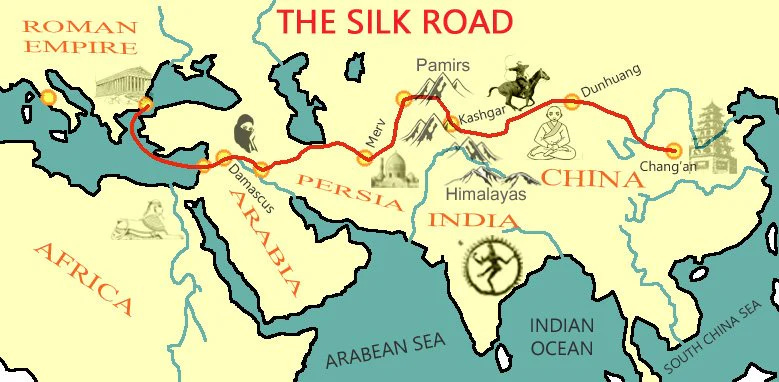
Why did Jews ever leave Judea on their own accord? Why else? For better opportunities. Judea/Palestine had long been a critical crossroads, caught between rival empires (and taxmen). That created hardships for all inhabitants. The area also suffered periodic droughts, prompting migrations. In these conditions, enterprising Judeans sought better lives elsewhere. Economic advantage beckoned along major trade routes, such as the 4,000-mile Silk Road network, which linked China to the Middle East and Rome for more than a millennium and a half beginning in the second century BCE. This is where the action was for sophisticated commercial, technological, and cultural exchange. “Few persons traveled the entire route, and goods were handled in a staggered progression by middlemen,” Britannica states. Urban centers that welcomed settlement and offered a chance at prosperity developed along the routes. In time, the locus of progress moved to the northwest.
Yet not everyone left. The remaining inhabitants mixed with newly arriving people, including the soldiers of the conquering Roman and Arab armies. Intermarriage and, no doubt, forced relations occurred. In time, many people converted to Christianity and then to Islam for various reasons, including more favorable tax treatment. The people known as “Palestinian Arabs,” in fact, have a diverse ancestry. Palestine was never “a land without a people.”
To repeat:
Jewish European descendants of people who had freely chosen to leave ancient Judea/Palestine established a project, Zionism, in the late 19th and early 20th century with the intention of displacing the descendants of Judeans who had chosen to stay.
Of course, this account differs radically from the standard fable. (In one incredible telling, the European Jews, having been evicted from their homesteaded property by Romans and Arabs, have a genetically based, collective Lockean right to repossess the land of Israel from its trespassers.) But the Zionist leader, David Ben-Gurion, Israel’s first prime minister, once saw Muslim and Christian Palestinians as something other than trespassers. In 1918 he and Itzhak Ben-Zvi (who would become Israel’s second president) published a book (in Hebrew and Yiddish) titled Eretz Israel in the Past and in the Present, which argued that the ancient Judeans were the ancestors of the Palestinian Muslims, Christians, and Jews. Ben-Gurion and Bev-Zvi wrote, “The fellahin [Palestinian farmers] are not descendants of the Arab conquerors, who captured Eretz Israel and Syria in the seventh century CE. The Arab victors did not destroy the agricultural population they found in the country … did not touch the local population.” In other words, the Palestinians were not late arrivals or trespassers attracted by Zionist development. Their families had inhabited and worked the land for millennia. (Contrary to the Hebrew Bible, the Israelites, as Canaanites, were also indigenous.)
You can find details and sources in historian Sand’s scholarly work, specifically The Invention of the Jewish People and The Invention of the Land of Israel: From Holy Land to Homeland. Also see my Coming to Palestine.
One more time for good measure:
Jewish European descendants of people who had freely chosen to leave ancient Judea/Palestine established a project, Zionism, in the late 19th and early 20th century with the intention of displacing the descendants of Judeans who had chosen to stay.
That seems unfair, as well as unwise—even in light of the horrific Jewish experience in parts of Europe, leading up to Hitler’s attempted genocide. While an ancient historical account cannot in itself provide a fair resolution to the conflict algorithmically, it is always better to know the truth.
TGIF—The Goal Is Freedom—appears on Fridays.
Very insightful, thanks!