
TGIF: Force, Direct and "Indirect"
The evil of force

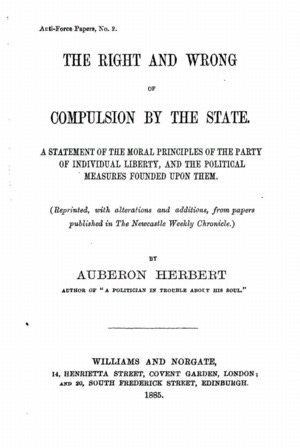
In “The Right and Wrong of Compulsion by the State” (1885), British liberal Auberon Herbert replied to those who objected to his call for complete individual liberty, that is, respect for the rights of all. For example, he took on big-government advocates who claimed that they also wanted to “diminish the use of force in the world.” Herbert wasn’t buying it.
He reported that the statists would say, “The rich unscrupulous man is in reality the man who uses force, and it is the exercise of force on his part that we are seeking to restrain by force on our part. The capitalist who uses force toward his work-people, compelling them to accept his terms, is as much to be restrained by force, in our opinion, as the man who helps himself by violence or fraud to the property of other people.”
Herbert wrote that he would reply: “Notwithstanding your protestations against force, you are acting so as to establish force as the universal law of the world.” What did he mean?
When we propose to use force against the capitalist because he forces his work-people to accept certain terms, we are confusing the two meanings which belong to the word force. We are confusing together direct and indirect force. Where I directly force a man, I say to him, “You shall do a certain thing, whether you consent in yourself or not to do so.” Thus, if I tie a man’s hands and empty his pockets, or if I pass a law saying that he shall not enter a public house, or that his child shall be vaccinated or educated, or that he himself shall only labor eight hours a day, or shall only labor for the state and not for a private employer, I am using direct force against him. I say to him, “Whatever your own opinion is in these matters, whether you give or withhold your mental consent to the act that is in question, I require that the act shall be done.”
I have misgivings about his word choice, which I’ll get to. For now, note that Herbert referred to the common meaning of “force”: an aggressor threatens to use physical force on a victim if he doesn’t behave as he is ordered. Uncoerced consent is not solicited. That notion of force, however, is frequently conflated with another notion, often called “economic power.” As he put it,
But when a capitalist says, “I offer employment on such terms,” or a workman says, “I will only work on such terms,” neither of them is employing direct force against the other. The employer may be indirectly forced to accept the workman’s offer, or the workman may be indirectly forced to accept the employer’s offer; but before either does so, it is necessary that they should consent, as far as their own selves are concerned, to the act that is in question. And this distinction is of the most vital kind, since the world can and will get rid of direct compulsion; but it never can of indirect compulsion, however much the growth of better influences may humanize and modify it.
Note the poor choice of words. Herbert would have been on firmer ground had he not called bargaining freely “indirect force.” By using that regrettable term, he added to the statist’s confusion of the two kinds of interaction, the kind in which consent is irrelevant, and the kind in which consent is central. Clearly, these do not differ merely in degree. In one, an aggressor forces a victim to do what the victim has a natural right not to do, or not do something he has a natural right to do. In the other, one party does only what he has a natural right to do: abstain from associating with someone because he dislikes the terms offered.
Someone might reply that people have to (are “compelled to”) work if they want to eat, suggesting that, in the second case, choice is not necessarily really free. However, no capitalist created that situation. Scarcity and the need to produce before consuming are features of reality. If those who object want to complain, complain to the creator of the universe. “Indirect compulsion,” Herbert wrote, “is a condition of life to which we have always been, and always shall be, necessarily subject; it is inseparably bound up with our joint existence in the world. The richest and most powerful man lives under indirect compulsion as well as the poorest and feeblest.”
Next, he moved on to “the mischief that arises when you make the existence of indirect compulsion a ground for employing direct compulsion.”
First, when you do so you at once destroy the immense safeguard that exists so long as one man cannot be compelled to accept another man’s view as regards his own life or happiness—that is to say, that the person who knows most about his interest and cares most about it—I mean the man’s own self—must give his consent to every action that he does; and you establish a system, founded on very puzzle-headed ideas, under which each man is not to be his own special guardian, but is to be put instead under the guardianship of (say) 10,000,000 of his countrymen and countrywomen.
In a free society, individualistically conceived, one must work, but how and where is open to a good measure of choice. Not so under when the state increases its power to “protect” us from free association. I’m reminded of Leon Trotsky's horrifying acknowledgment that in “a country where the sole employer is the state, opposition means death by slow starvation. The old principle: who does not work shall not eat, has been replaced by a new one: who does not obey shall not eat." (The Revolution Betrayed, 1936)
“Second,” Herbert continued, “observe, that in opposing such indirect force, as is tyrannously used, by the weapon of direct force you fall into the same mistake as those … who try to repress a crime by methods more brutal than the crime itself.”
[H]e who uses direct force to combat indirect force only restrains one injury by inflicting another of a graver kind, places the fair-minded people as well as the unfair-minded people on the side of oppression, and, by thus equalizing the actions of the good and bad, indefinitely delays the development of those moral influences to which we can alone look as the solvent of that temper that makes men use harshly the indirect power resting in their hands. Do we wish to make men juster in their daily intercourse with each other? We shall certainly not succeed by acting more unjustly in return, for however unjustly a man may use the indirect power that he possesses, his injustice will always be surpassed by those who violate the universal rights of men by applying force directly.
Notice that Herbert was aware that what he regrettably called “indirect force” could be employed “kindly or harshly, scrupulously or unscrupulously.” Even in their consensual relations, people may treat one another disrespectfully. Herbert believed that freedom (and competition) would penalize such treatment in favor of a more a civil society.
TGIF—The Goal Is Freedom—appears on Fridays.
Always enjoy your brilliant essays. I remember you from the online libertarian discussion group many years ago. Hope you're well!