
TGIF: Bravo, Bezos!
In defense of business and billionaires

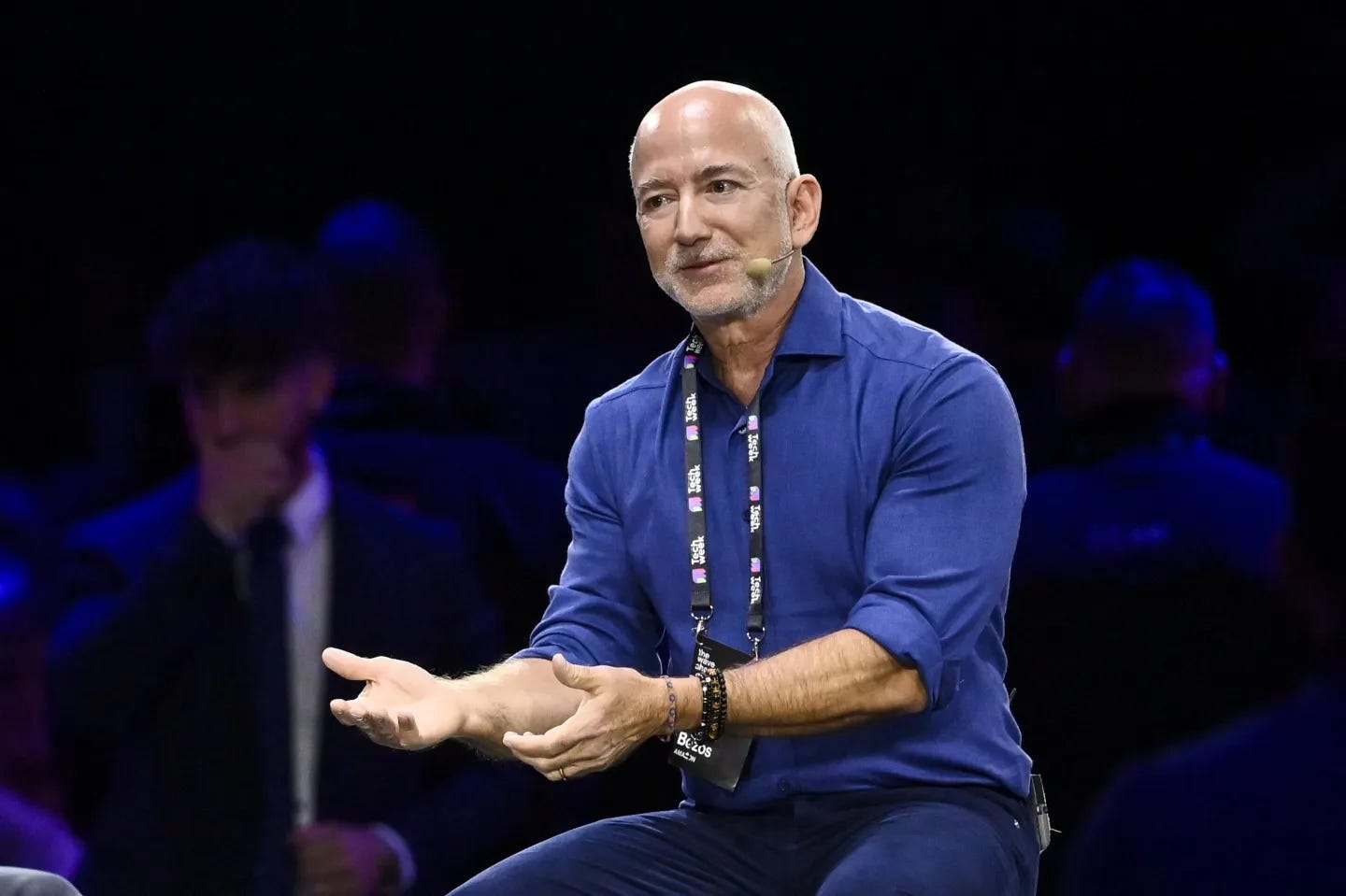
[I]f we ran Amazon the way New York City runs their school system … [y]our packages would take six weeks to arrive, we’d have to charge you a $100 delivery fee and then when the package did finally arrive, it’d have the wrong item in it anyway. —Jeff Bezos to Andrew Ross Sorkin on CNBC
When an American businessman defends the large fortunes made—that is, earned—in the marketplace, it’s something to celebrate. Jeff Bezos, the creator and head of Amazon.com, did just that in a recent wide-ranging interview on CNBC’s Squawk Pod with host Andrew Ross Sorkin on May 20, 2026.
While his remarks on political philosophy did not go far enough in defending the morality of money-making, they went farther than anything we have heard from a businessman in quite some time, if ever. In this age of rampant anti-rich bigotry—when prominent politicians, darlings of much of the old and new media, say that should not exist—Bezos’s remarks are refreshing indeed.
Have a look:
“Let’s say you start a burger joint, and you have 10 employees. And you make a little bit of money. You have this one outlet. And by the way, this is the most delicious burgers in the world. People love your burgers, Andrew So then, you open a second outlet. And now you’re making a little bit more money, and you have 20 employees. And you open a third outlet. By the time you’ve opened a thousand outlets, you are a billionaire.…
Bezos here described not only what can happen in the market, but also what does happen. As Bezos said, “And by the way, this is a real-life story. It happens all the time. It’s In-N-Out Burger. It’s Raising Cain’s Chicken.” He could have named many other examples.
Then he went to the heart of the moral issue. If it’s okay to make money from a few burger outlets, but something wrong with making a billion dollars from a thousand, “[a]t what point did that money all of a sudden become unethical? It didn’t.”
Here is Bezos, one of the richest men in the world, claiming that being worth a billion dollars or more is not immoral when it comes from pleasing consumers.
He elaborated:
There was one outlet. Then there were two. Then there were three. The way to you made the billion dollars or hundred million dollars or 10 million dollars or anything is that you create a service that people love, and if millions of people choose your service, you’re gonna end up with a billion dollars.”
Mind-blowing, no? This wasn’t Ludwig von Mises or Ayn Rand or Milton Friedman defending the earning of great wealth through production. It was a guy who actually did it. He’s proud, as he should be. He innovated, executed his plan, benefitted hundreds of millions of people beyond calculation—and, as a result, did extraordinarily well for himself. (Like other wealthy people, Bezos consumes only a tiny percentage of the total value he creates.)
Why would anyone begrudge such a person the fruits of his labor? Many motives can explain the animosity, among them, envy and sheer hatred of achievement. To be more charitable, however, we can add “ignorance” to the list. Some clueless people may really believe that Bezos has more because others have less.
He took a stab at explaining this phenomenon: “A lot of people don’t understand the zero-sum fallacy,” he said. “They think if there’s a bunch of wealth over here, there’s a fixed pie. We’ve got one pizza, and there are seven people and eight slices. Who’s gonna get two slices? That is not how economies work. So it isn’t a fixed pie. It grows.”
I wish Bezos’s understanding ran a bit deeper. He’s right about the zero-sum fallacy. Individuals value things differently. When Jones pays Smith $5 for a hamburger, he demonstrates at that moment that he wants the burger more than whatever else he might have bought with the $5. Vice versa for Smith. Each gives up something he wants less for something he wants more. But that means each makes a profit. We think of only the money side of a transaction as reaping a profit, but that’s not really true. A little introspection would clear up the matter.
How do we know that each side expects to profit? The trade would not occur otherwise. Libertarian journalist and commentator John Stossel calls this the “double thank-you” at the checkout counter. (We’re not infallible, of course, so buyer’s and seller’s remorse is possible. Live and learn.)
But Bezos would have been on firmer grounds had he dropped the popular pizza analogy. No wealth pie exists. It did not mysteriously appear, prompting the question of how to divide it. Wealth comes from human intelligence, the transformation of matter from a less-useful form to a more-useful form, and trade. Particular individuals engage in identifiable actions, interactions, and transactions with their property and labor. No disembodied process occurs. Society, as the 19th-century French laissez-faire economist Destutt de Tracy, emphasized, is a series of exchanges.
Ah, but is that really true? Don’t groups—sometimes very large groups—create wealth by working together? Yes, of course. However, that does not change the story. For one thing, one person often launches and organizes an enterprise. Moreover, firms, partnerships, and corporations are associations of freely cooperating individuals, each of whom chooses to enter relationships with the others by agreement or formal contract—that is, via transactions.
One last point on this. Bezos is surely right to emphasize that in the market, one gets rich by furnishing consumers, directly or indirectly, with goods and services for which they are willing and even eager to trade money. However, he should have gone a step further to herald the fact that the virtuous pursuit of happiness (self-interest) in a free institutional environment necessarily promotes the “general welfare.” In other words, as Mises and Rand never tired of pointing out, individuals have a deep harmony of rational or “rightly understood” interests. Bezos, like other great producers, has indeed made the world better off, but that is not what justifies his life or his fortune. He, like you and I, is an end in himself.
Let’s give Bezos the last word:
If I do my job right, the value to society and civilization from my for-profit companies will be much, much larger than the good that I do with my charitable giving. And I think this is an important point to make because people forget, or they sometimes don’t see, that when you create something like Amazon and you’re saving—I get letters from new mothers all the time that say, “I have no idea what I’d be doing right now if I didn’t have Amazon. Thank you.” Or what we did in the pandemic, when people could really see what an essential service we provided to them…. Amazon creates tremendous value. And by the way, all companies are creating value of some kind. That’s why people are voluntarily giving them money.”
TGIF—The Goal Is Freedom—appears on Fridays.
Amazon's entire distribution network - the thing that enables 2-day Prime delivery and destroys competitors who can't match it - is built almost entirely on PUBLICLY-financed infrastructure that Amazon pays a negligible share of maintaining.