

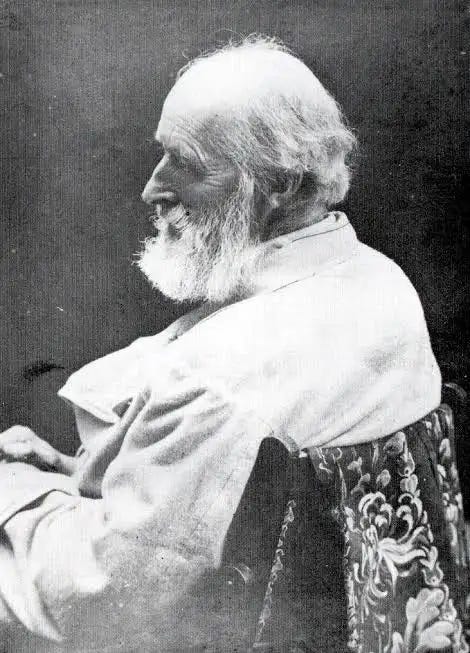
British individualist Auberon Herbert (1838-1907) minced no words when he spoke against socialism. After demolishing the notion that a “social entity” exists separately from the individuals who comprise it, he concluded his debate with J. A. Hobson by writing something that today’s socialists might ponder.
He began with the bluntest of assertions: “The truth is, that the socialist, unknown to himself, is the most antisocial of all human beings, and, if he had his way, would render all true social action impossible.”
Could he back that charge up? Let’s see. “His creed of universal compulsion and wholesale effacement of the individual,” Herbert wrote, “is the very essence of antisocialism. The true social life is the sum of all individual differences and energies; and if these component elements are to be suppressed, the resulting whole, the entity, necessarily disappears.”
Herbert, a protege of Herbert Spencer, understood that society enhances individual well-being through voluntary cooperation, namely, trade (in goods, services, and ideas), the division of labor, specialization, and—importantly—money, which greases the gears of commerce. A lone individual or family would be dirt-poor. “Coerced cooperation” is a contradiction in terms. “Voluntary cooperation” is redundant. It requires personal liberty so that each individual can freely and rationally judge how best to serve his own interests by catering to consumers' wants—and act on that judgment without interference from force-wielding people.
He drove home the point:
Mr. Hobson—will he forgive me?—is the deadliest enemy conceivable to his own creation, his well-beloved social entity, just because he makes war upon the individual. In slaying the unit, he slays the whole, that is compounded from the units. In truth, under his system the individual, who is the living active element of the social entity, and apart from whom the social entity is a mere phrase and nothing more, is not simply to be suppressed, but is sentenced to an even harsher and more ignominious fate.
Herbert compared socialism unfavorably to previous tyrannies:
Hitherto, most of the tyrants and autocrats, who have tried the experiment of fashioning the world in their own image, have been content, like the present German emperor, with planting their imperial feet upon the individual, and so suppressing him; but it has been left for Mr. Hobson and his friends to discover a more subtle and deadly way of abolishing him. They have buried him alive in the social entity, and explained him away. Even the modest luxury of a theoretical existence is denied him at their hands. And what “plowing of the sands”; what good literary labor thrown away! For, as we have just seen, the more you suppress the individual, the further the possibility of the social entity, in its true sense, recedes. There is only one result you can get out of the suppression of the individual, and that is the organized dominant faction triumphing over the defeated faction.
Make no mistake:
Every form of socialism only represents the dominant faction—that and nothing more; and if socialists wish to bring names and things into a true correspondence with each other, they should change their name and call themselves the antisocialists. But that is to ask for much. For they are at present lost in the region of phrases, and have yet to learn the simple truth, that there is no real social life conceivable apart from the free movement of the individual—apart from the free play of the individual will and conscience.
The language of political economy might have developed differently. It might have come about that the great ideological contest was between the voluntaryist individualist socialists and the coercive collectivist statists. That would have been faithful to the facts. After all, under capitalism, the locus of decision-making is within the society of free individuals. Under socialism, the locus of decision-making is within the coercive state apparatus. But it did not work out that way, and nothing can be done about it now. But let’s not fret. We have bigger fish to fry. The intellectual struggle for individualism (egoism), property rights, and capitalism—that is, full liberty—must defeat both the red and blue threats.
TGIF—The Goal Is Freedom—appears on Fridays.
I think you're reading too much in the word "cooperate". The simplest definition I've found is "to work with others to achieve a common goal", which IMO doesn't imply voluntary action. Spencer uses the word "co-operate" or "co-operation" 19 times in "The Great Political Superstition" (https://www.freedomcircle.com/source/man-state-great-political-superstition) and makes the point that "[W]hen, with diminution of warfare and growth of trade, voluntary co-operation more and more replaces compulsory co-operation".
Brilliant essay. In this time where Democratic Socialism has taken on a life of its own, it’s good to be reminded that the foundation of human life begins and ends with individuals voluntarily cooperating with one another. It’s somewhat astonishing how few people understand this self evident truth.